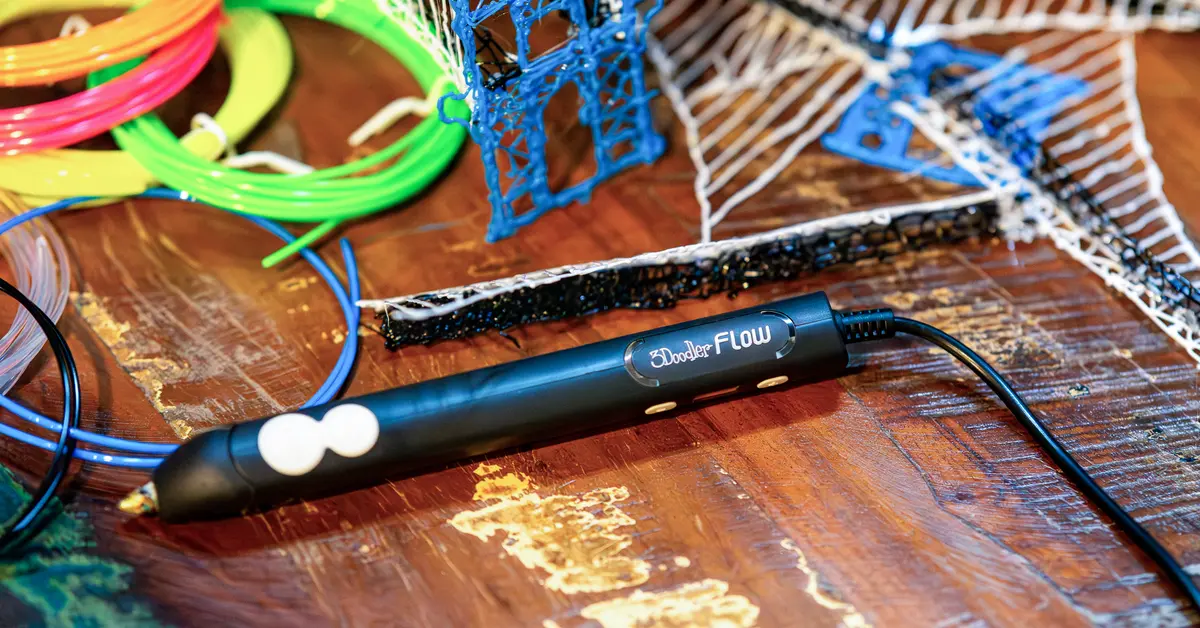

Top choice
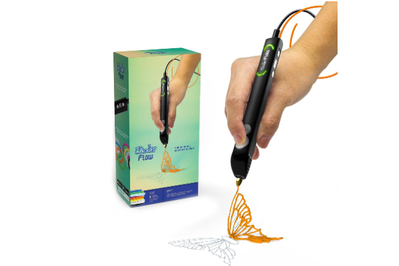
Comfortable to hold and easy to start using right away, this pen comes with 3Doodler’s excellent customer service. The only downside is its proprietary filament.
3Doodler Flow offers the best drawing experience for people ages 12 and up who want to start working with 3D pens. In our testing, it drew clean lines on a plastic that hardened quickly, was easy to use, and was one of the most comfortable pens to hold. Works with most tip sizes, too. In addition, 3Doodler’s customer service is the most responsive we’ve encountered.
It has a nice ergonomic shape that is comfortable to hold. 3D drawing projects can take a while to complete, but the Flow’s well-designed, soft-textured plastic exterior makes the lightweight pen easy to hold no matter how long your drawing takes.
The design allows the index finger to rest naturally within reach of the pen’s two buttons, which start or stop the flow of the pen and control its speed. We found that the shape of the pen was perfect for getting good control while drawing. The Flow also stays cool even during long drawing sessions.
It pulls out motionless, even plastic strips as you draw. The lines hardened quickly and stayed when we drew over them; in contrast, most other pens hold a soft thread and pull it (like a low-grade hot glue gun), twisting our drawings.
Thankfully, Flow gives you the option to press the button once to eject – great for filling work or cutting simple stencils – or eject “manually” by holding the button and stopping ejection when lifting, giving you better control for tricky or complex sections. Flow’s fast and slow settings are both comfortable with a standard drawing.
Loading and unloading the filament is easy. The Flow follows a standard 3D-pen filament loading process, similar to a glue gun. To release the thread, you double-press the speed button, which moves the thread backwards until the thread is loose enough to come out. 3Doodler recommends emptying the pen after use to prevent long-term damage from keeping the plastic inside.


It allows you to choose between two heat settings. The settings are designed to accommodate ABS plastic (which melts at about 380 degrees Fahrenheit) or PLA plastic (about 360 degrees), two options in 3Doodler’s filament lineup (more on this topic below).
It doesn’t close. When 3D pens first appeared, one of the most common problems was that the filament would clog – the molten plastic would harden and get stuck inside the pen. However, none of the 3Doodler pens we tested, including our previous pick, the Dala+, and the company’s kid-friendly models, blew us away. The flow is also different.
It offers more flexibility in tip sizes. The Flow is one of the very few pens we’ve tested with the option to purchase additional tip sizes (you can use 3Doodler’s Pro pen, too). One of our experts strongly recommends extra tips, as thinner tips give you more control over detail work, and thicker tips are better for filling larger areas more quickly.
After checking out various tips, we agree. If you want to have more control in the detail work or to speed up the filling, additional tips will help you. 3Doodler also sells two ribbon-like shapes that can be useful for adding texture. You don’t have to buy these tips to get a good experience with Flow, but they definitely help.
One caveat: Make sure the pen is hot when you change the tip, or you risk permanently breaking your pen.
3Doodler’s customer service is helpful and responsive. As part of our first round of testing, we sent each 3D-pen company an email asking if it was safe to use third-party filaments. 3Doodler responded within minutes – the fastest of any company we asked – and was one of the few companies to respond at all.
We also had the opportunity to deal with 3Doodler customer service when our original Create pen stopped working after being shipped overseas twice. As always, customer service responded within minutes via email. Within 25 minutes of the initial response, the service representative had determined there was an electrical problem and offered to send a replacement.
All 3Doodler pens are covered by a one-year warranty.
Flaws but not dealbreakers
Not compatible with third party filament. The Flow comes with eight 10-foot-long spools of plastic filament, which is more than you get with most pens we’ve tested. However, if you don’t want to void the Flow’s warranty, you’re stuck using a plastic 3Doodler. Although it is critical that third-party filament is not compatible, the price of the 3Doodler plastic is now within the range of standard plastics, so this limitation is not as bad as it was.
The thread has a chemical smell. As was the case with all the other pens we tried, with the Flow, the ABS filament gave off a chemical-like smell, while the PLA filament smelled like maple syrup.
It emits a slight car noise while drawing. Although this noise is annoying and not unique to this model, it is not loud enough to hurt someone in the next room.
We wish the cord was longer. The Flow has a 5-foot cable, which is the standard length for a 3D pen, but it will feel short if your table or other work area is in the middle of a room far from the outlet, as ours was. You should have plenty of slack in the string so you don’t feel any pull from the top of the pen as you work. We recommend using an extension cord if you don’t plan to use the pen directly in front of the outlet.