
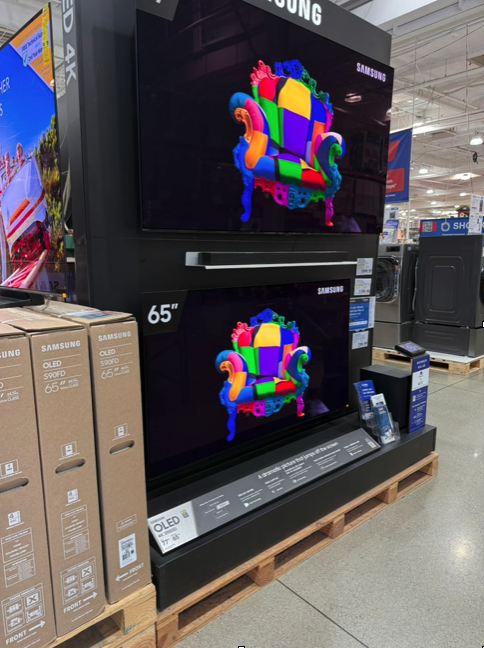
After OLED, in terms of image quality and prices, the next step “down” are TVs with mini-LED backlight, better known as Quantum TVs.
Non-OLED TVs: QLEDs and “regular” LED TVs
I mentioned in a previous article in this series that OLED picture quality remains consistent, even when viewing from side angles. Here are two pictures of my Hisense Quantum TV, one from the front, one from the far side. It’s easy to see that the image quality deteriorates a bit, especially from far to the side.

Quantum TVs – Without going into “Quantum” technology. (let’s think of it as a marketing term like advanced physics films and nano films.) Many of them have “mini-LED” technology, connected to what are called “zones.” Zones are important to improve image quality in dark scenes. Here is the reason.
Spots, Mini-LEDs: For many years (LED TVs – used to be called LCD TVs) were all “backlit” with a single light source at the edge (called “edge lit”) the backlight is responsible for providing the background light for all the pixels that make up the image.
That is, the white light source outshines the light from the LEDs. The data that feeds the color LEDs determines the color that passes through and hits your eyes. Problem: Traditional LEDs leak light so if the data says, this pixel should be black – that was impossible due to white light leaking. The result – black turns into dark gray or lighter, and that translates into a picture with worse contrast. That’s how all types of LEDs work except OLED. More on that, in a minute.
One of the light sources of all TVs is how they were designed. An entire scene, for example, might be a very dark night scene with one bright street light. In order for the street light to look good and bright, the backlight of the TV must be bright enough to pass most of the light to the LEDs. But when the backlight is bright, light passes through all the pixels, even the ones that call for no light. That’s the failure of LEDs that aren’t OLEDs. The result is that the dark area ends up very gray, not much darker than it should be.
With zones, instead of a single backlight source there can be dozens or even thousands of different lighting zones, each controlled separately. The more areas, the better the handling of those dark scenes – e.g. The rear light is the only area with street light that needs light. All other areas can be dimmed so that less light leaks in, resulting in the image in all other areas appearing dark, close to pure black. Close to what the picture calls for.
My 100″ HiSense has 1620 different zones! Some have many times more than that. This means that each area can be really small. Now the number or locations will affect the price. For example, my TV is what HiSense calls their U8 series. The less expensive U6 series (pictured above) has only 192 slots. More is better. But no matter how many areas, OLED is still better at producing blacks, and thus, a better picture overall.
Low cost, basic LED TVs:
Although picture quality continues to improve, and prices continue to drop, your standard LED TV cannot match the multi-zone Q type (with its “nano structure” LEDs) and “mini-LED” light sources, that is, they cannot match the picture quality of Quantum TV. The thing is, for most people those are good TVs, better Qs, etc. Even the basic ones have better looking pictures than that LED TV you bought 10 or 15 years ago. And, of course, the prices are low. Be aware, when looking at 77″ and larger sets, almost all sets have more space and some more advanced technology than you’ll find, when it comes to a standard 43″ TV – these days starting at less than $200! 42” Plasma TVs were $25,000+ 25 years ago!
Value Comes into Play
Prices vary greatly between technologies. So, to paint you a (supposedly) picture here of how prices can work. I looked up prices on different Samsung 43” TVs at Best Buy:
Their basic 43” is currently $219 while the Starter Q (quantum) is $399, and the top-of-the-line multi-zone Q, which is less expensive, is $1299. Samsung, however has at least half a dozen other models between that $399 and $1299. Ironically, Samsung has an OLED under their Q mini-LED line (I don’t know why, but they also have very expensive OLEDs).
I will remind you again, another advantage of QLEDs is that they are less bright than OLED. However that is not a problem except in very bright rooms (daylight comes in).
If you don’t like to watch movies or like to stream content that is often very dark, then the locations are not that important. Keep that in mind when working out your budget versus size versus any technology.
Bottom line: As for Which Technology – from many perspectives:
Bigger is Better! (If you have room.)
OLED offers the best picture, and can produce pure blacks for excellent saturation and contrast, and looks just as good from an angle as the front. OLED prices are very high, but still not crazy – considering the 77” can be under $2000, but the largest OLEDs – 97” – 100” are still reasonably priced with list prices. starts over $10,000 (but still more expensive than 2 years ago – when $25K was street price).
Q (Quantum) TVs are next best – with the best “mini-LEDs” in that category, the more areas the better. And they are the brightest. But they will come out with picture quality if you are viewing away. Most people will find the image quality of Q min-LED sets to have a good picture. It’s people who want the best picture that want OLED.
Standard LED TVs are usually single-panel, and relatively inexpensive, with very little difference in their image.
That’s enough. I hope, so far, this has helped you decide which type of TV will be best for your room, your viewing experience and your budget. See 3rd and the last article in this series:
Part 3: Smarts, and Soundbars