
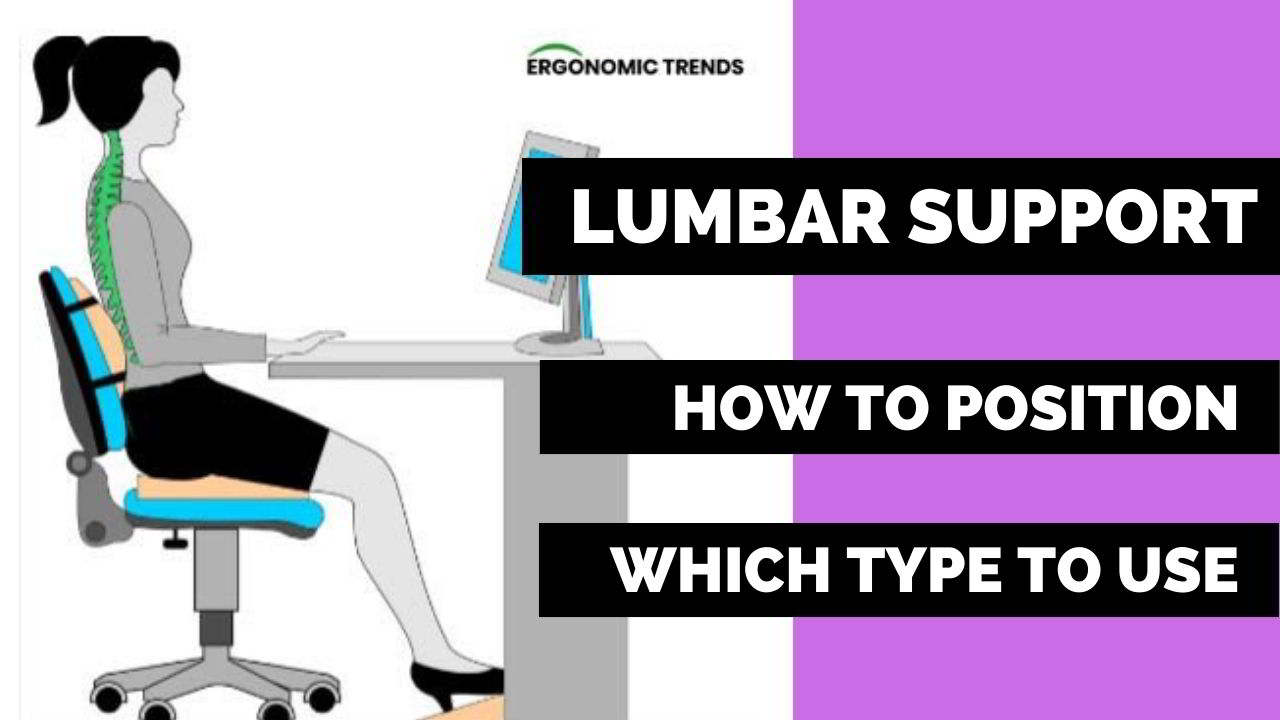
You’ve probably learned that good lumbar support helps keep your back healthy and pain-free when sitting. However, like everything, the devil is in the details. How high or low should the lumbar support be? Are some designs better than others at protecting your back? Are there other sitting postures that can mimic the benefits of having lumbar support? In this article, I will go over the important things you need to know.
Where is the Lumbar in your back?
Let’s start by looking at basic anatomy. The human spine can be logically divided into 3 sections based on the natural curves seen in the spinal column:
- Cervical spine
- Thoracic spine
- Lumbar spine
Lumbar refers to the last part, or lumbar spine. Located at the bottom, as you can imagine, this is the region under the most pressure as it supports the weight of the entire spinal column.
To find the lumbar area of your back, stay straightand use the back of your hand to run upwards from the sacrum (above the tailbone). You should feel an inward curve as your hand slowly moves up along the spine. This is your lumbar spine region.
How High or Low Should I Place the Lumbar Support?

To answer this question, let’s skip to the end and look at what exactly is the purpose of lumbar support.
The purpose of lumbar support is to properly support your lumbar spine so that the natural curvature of the lower back is better preserved. This is where your lumbar is happiest, better able to handle and distribute the load placed on it like in an arched bridge.
With that said, for most people, a good starting point is to adjust the lumbar support so that it is right in the middle of the lumbar spine where the internal bending is most felt. Then, based on the size and depth of the lumbar support, make some small changes. You will know that the position is correct when the lumbar support completely fills the gap created by your lumbar spine when you are sitting straight without pushing your lower back too far forward.
What Kind of Lumbar Support Should I Go With?
In the market, you will find many types of lumbar support, and while some are better than others in general, it ultimately comes down to your body anatomy and sitting style. Some general guidelines for choosing a good lumbar support are:
- A lumbar depth between 0.6” to 2” will work well for most people.
- People with a higher BMI (Body Mass Index) will prefer a longer lumbar support that is aimed higher on their back.
- Women will benefit from more pronounced lumbar support due to increased curvature in their lower back (lordosis),
When it comes to choosing the right lumbar support, the following are all viable options:
Adjustable Lumbar Support (Office Chairs)

Adjustable lumbar support refers to that which can be adjusted on at least one side of the office chair. Generally, this means a adjustable height lumbar support. These days, it’s rare to find out what might be fixed depth like that.
Other office chairs with decent lumbar support are SIhoo M57, NeueChair, and Secretlab Titan Evo.
Dynamic Lumbar Support (Office Chairs)

With an adjustable lumbar setting, the backrest on the office chair automatically adjusts to your body and sitting position to provide continuous lumbar support. While it sounds good in theory, in practice how lumbar flexibility actually works comes down to the particular office chair in question.
The Herman Miller Embody is the highest office chair with the strongest lumbar support on the market today. Instead of one solid piece, the backrest in Embody consists of hundreds of flexible parts that move and bend with your back. The pixelated structure cushions and supports your entire spine, not just the lumbar region.
Outdoor Lumbar Pillow (Gaming Chairs/ Outdoor Accessory)

Outdoor lumbar cushions can be found on most gaming chairs or as an outdoor group accessory. They provide moderate to excellent lower back support depending on shape, size, and depth.
In most gaming chairs, the outer lumbar cushion is just average. The advantage is that it can be moved directly to the area of your lower back that needs support. Make sure the pillow is not completely “free floating”, and is designed to stay in place once you’re in a new place. In the GTRacing gaming chair for example, the lumbar cushion is attached to the straps to protect it as you go up and down.
The most ergonomic external lumbar pillows are those that are sold separately as an accessory. They usually come with high quality foam inside and a more ergonomic shape. For people with low back pain, an outdoor pillow with a cut around the back pelvic muscles has been found to be very comfortable and supportive. Cushion Lab offers lumbar support that complements this design.
Roll up the towel
And finally, if budget is a concern, experts say even a folding towel placed behind you can be helpful in maintaining the natural curve of your lower back. Use a small towel that doesn’t end up pushing your entire back forward.
What Are Some Healthier Postures for my Lumbar Spine?
Even the best lumbar support can do much to protect your lower back. This is because any long-term sitting position ends up being a liability to your spine as pressure builds up on the same vertebrae and discs involved in maintaining that posture.
To combat this, a good way is to alternate between sitting positions that encourage a neutral spine, in addition to taking microbreaks from time to time.
So what are some sitting positions that naturally maintain the curvature of the lumbar spine? Here are a few of them to consider:
Swinging

Squatting in front of your laptop may not be the most attractive way to sit, but there’s a reason why this age-old sitting posture has endured, researchers say.
First, squatting allows you to sit in a way that bypasses most of the negative health effects associated with immobility. That was the conclusion of a team of researchers who studied the living habits of the Hadza, a modern hunter-gatherer group in Tanzania who spend up to 10 hours a day sitting idle. Their secret? This nation squatted most of the time while sitting, which scientists calculate can do up to 40% of the muscle work of walking and up to 8x as much as sitting. Think of it as a natural version of active living.
Second, squatting protects your lower back better than regular sitting. When we squat, the hips automatically open and move forward to maintain the natural curvature of the lumbar spine. As long as you don’t squat when you squat, it’s actually very difficult not to assume a neutral spine in this position.
See this post for tips on how to incorporate squatting into your squat routine.
Kneeling down

Kneeling is another sitting posture that naturally protects your lower back and lumbar from excessive stress. For continued comfort, the use of a kneeling chair is recommended.
A distinguishing feature of a kneeling chair is a reclining seat that drops your knees below hip level when you sit. Compare that to sitting in a regular office chair, where your hips and knees are level.
A study by AC Mandal showed that sitting in a reclining chair with knees down can significantly reduce lower back fatigue, making it easier to maintain the lumbar curve. The angle of the seat also helps shift part of your body weight to your thighs, further diverting pressure away from your back. This is why students naturally tilt their chairs forward in school when they sit when their backs are tired.
If you choose a kneeling chair, look for one that creates a hip-to-knees angle of 20 degrees to get the maximum benefits of refusing to sit.