
My husband got dressed School of Rock this spring and, well, that was it. Both of our children—ages nine and seven—have wanted to play guitar ever since. Whether it’s a genuine musical interest or just the idea of ”sticking to the man,” I can’t say. Lessons are off the table…but we live in a city apartment, and finding room for a full-sized guitar (and the practice chaos that comes with beginners) is a challenge of its own.
So when I got the chance to review the Enya Cyber-G Pocket, I was hoping it might give them a taste of playing the guitar—a low-key way to find out if the interest is real before committing to lessons and a full instrument. What I got was something that was hard to pin down, and a lot more fun than I expected.
A Quick First Look: What is the Enya Cyber-G Pocket Guitar?

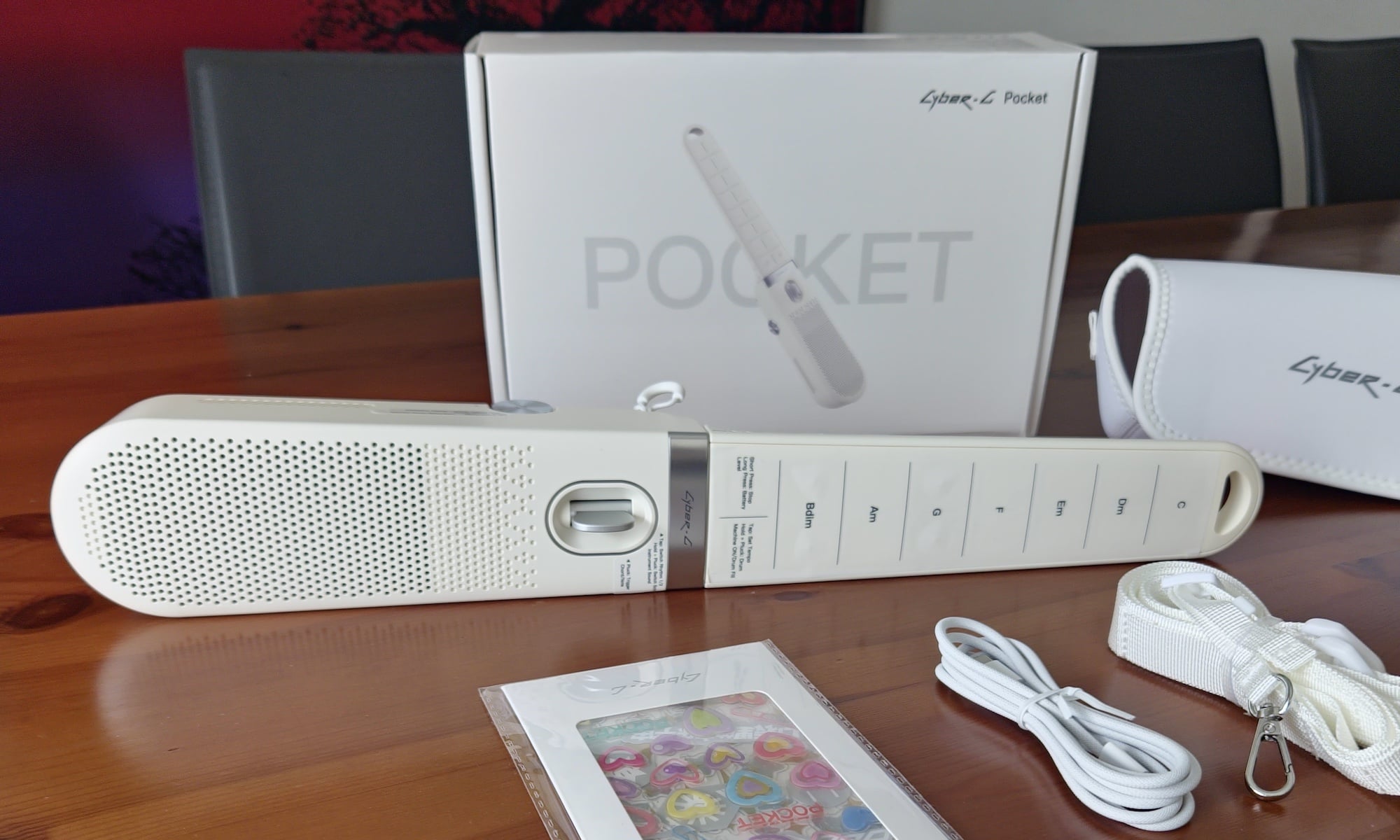
The Cyber-G Pocket is not a guitar in any traditional sense. There are no strings or frets. A smart app-connected instrument with 14 customizable chord pads, a pick-style strum trigger, and a built-in 20W Bluetooth speaker—all rolled into a 0.8kg device.
The closest comparison I can make is Guitar Hero, except for the game controller, it’s an actual device with built-in rhythm and accompaniment logic. You touch the chord pad, pull out a selection, and Cyber-G automatically fills in the bass and drums. It sounds like a band, but in a way, it’s you.
If you’re looking for a guitar learning experience, this isn’t it—and Enya doesn’t really do it any other way. But if you want something that makes you feel like music immediately, it delivers.
What’s in the Box + Enya Cyber-G Pocket First Impressions
Inside you get Cyber-G Pocket, protective case, shoulder strap (included with wristband), charging cable (USB-C), and a pack of DIY stickers for personalization
First impression out of the box: this thing feels well made. The weight is comfortable in your hands, the buttons have a solid click, and the folding mechanism feels smooth and engineered. In fact, I was determined to get the toy. It doesn’t sound like one.
Setup: Is the Enya Cyber-G Pocket Easy to Use?

Setup is quick. Download the Enya Music App, turn on the device, connect via Bluetooth, and play in minutes. The battery comes charged, so I was able to turn it on and start playing right away.
The app got me through the basics clearly—connecting to Bluetooth was a breeze. I was playing my first Cruel Summer song within five minutes of turning on the device. That speed is important. With kids involved, anything that requires patience before the fun part is a battle.
Living With Them Every Day

The moment you won me over
Okay, so I started playing with it while the kids were around. They stopped. For about twenty minutes, they watched and listened. For a technology-forward tool aimed at beginners, that’s a real letdown. The sound from the small device was impressive.
Sing and Play vs. Solo Mode
The Cyber-G Pocket has two main types, and understanding them changes how you use them.
In Sing and play modeyou press the instrument chord pad and hit the built-in selection. Plays a full song with automatic bass and drum accompaniment. He provides rhythm and chord progression; fills the rest. This is where the “one man” claim holds. I ran and passed Here comes the SunThe chord’s change while singing—and it sounded like a full song. If you’ve ever wanted to play acoustic guitar by the fire but don’t have the years of practice required, this is the solution.
Solo mode it lets you play individual notes—like a regular instrument, a little like an auto-harmonic device. Side LEDs tell you which mode you’re in: yellow means Solo, anything else means Sing & Play.
I spent most of my time on Sing & Play, and it’s the most fun of the two for casual play. In a way, it reminded me of karaoke—but with a guitar in your hands instead of a microphone. That framework alone makes it click with tweens, teens, and adults who just want to have fun with music without a curriculum.
Enya Music App Review: Useful, But Seamless
The Enya Music App has a lot going for it. You can access the tones of 15+ instruments (electric guitar, grand piano, flute, guzheng, melodica, and more), customize your 14 chords, choose from five drum kits, and follow active song tabs. There are also built-in tutorials and videos.
That last part comes with a caveat. If you’re watching the tutorial in the app, you have to turn off the video to adjust the settings—you can’t do both at the same time. I found it easier to download instructional videos from YouTube using the laptop, then use the phone to control the app only. It’s not a dealbreaker, but it’s worth knowing before you settle on a career.
I also missed the instrument in Sing & Play mode at one point and couldn’t find it right away. Adjusting the short press of the MODE button on the side—easy once you know it, a little confusing if you don’t.
The Story of the Screen I Didn’t Expect
The biggest point of contention for me as a parent: this product needs an app, which means it needs a screen. My kids already spend more time on their tablets than I would like, so giving them a device that connects to a phone or tablet so they can get the full experience gives me pause.
That’s not a mistake—an honest argument to be made by any parent considering this as a children’s tool.
Enya Cyber-G Pocket as a Bluetooth speaker: Is it Good?
As a fun bonus, the Cyber-G Pocket becomes a 20W Bluetooth speaker when folded. Sound is heavy on a device this size, and for us, it handled everything from pops to podcasts without complaint. If you’re camping or at the beach house, this replaces both your speaker and your evening entertainment.
Battery life is rated at eight hours of playtime on a single charge, with a two-hour recharge time. In my use, that is tracked.
Enya Cyber-G Pocket as a folding guitar for flats
At 0.8kg and fully collapsible, this fits into a backpack without drama. For a family in an apartment, that’s especially important—we don’t have a dedicated music room, and keeping a full guitar means finding an empty corner. The Cyber-G Pocket stays in the bag. I can throw it on a weekend trip to the beach house or the mountains without rethinking what else I’m packing.
What I liked
A fast feedback loop. You press the chord pad, strum, and something musical happens. No investment takes months before it feels good.
Build quality. It feels solid and purposeful, not like a toy that is passed around as a tool.
The speaker. Good sound for the size, and useful even when not “playing”.
Portability. It’s foldable, lightweight, and perfect for an apartment. This is a rare gadget that solves the space problem.
The kid factor. My two stopped what they were doing and watched. That’s nothing.
What I didn’t do
Application dependencies. For kids especially, any device that requires a connected screen is a trade-off parents should be aware of.
Price. At $189.99 on Amazon, it’s not a bargain. It’s a fun, well-made gadget that teaches vocal awareness, rhythm, and tempo—but it won’t teach you how to play guitar.
Final Verdict: Who Is This Really For?
Who will love the Enya Cyber-G Pocket
Teens, teens, and young adults who want to make music now, without years of practice first. Apartment dwellers or anyone lacking storage space. Parents looking for a creative space that goes well. Music lovers looking for a portable Bluetooth speaker that also plays like an instrument. Adults who want to crash while singing without taking lessons.
Who should skip it
Anyone hoping this will teach a kid to play real guitar—the skills don’t transfer directly. Parents who want to limit their children’s screen time. Serious musicians looking for a practice tool with a real build technique.
My Honest Take
I arrived skeptical and left enchanted. It’s not a guitar, and calling someone one is offensive. It’s its own thing—a brilliant instrument that lowers the bar for musical enjoyment as far as it will go. According to the School of Rock’s own research, early exposure to music builds real cognitive and emotional skills in children—so even if this isn’t a traditional tool, getting them involved in the progression of songs and rhythms is an important starting point.
Can I recommend it? For the right person, yes—especially anyone who wants to make music in a small space without committing to lessons or a full instrument setup. It’s definitely a fun new way for our family to get together.