
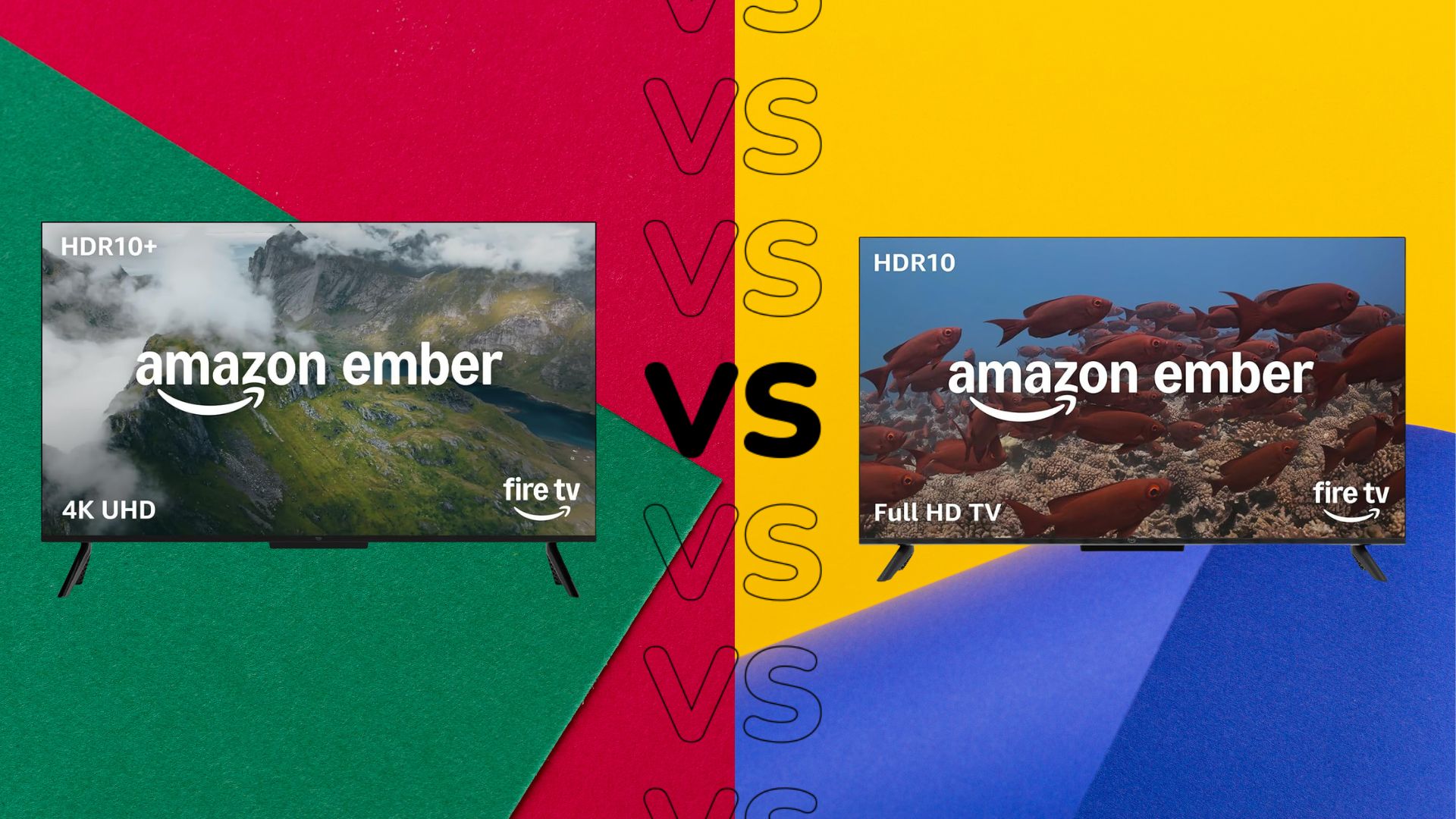
Amazon has given its series of TVs a refresh, and if you’re trying to decide which one is right for you, we went through the trouble of comparing the newly made Ember 4-Series and 2-Series with Fire TV.
There are a few differences, and as always with these types of comparison articles, it will depend on what you want from your new TV purchase.
Design
There isn’t much difference between the Ember 4-Series and the Ember 2-Series in terms of design, and in this case, that’s a good thing.
Amazon has made both of these TVs easy to set up and run. All you need to do is wrap the feet and you’re done. Feet fit on both ends of the TV, so whatever model you end up going for, make sure your furniture has enough space to accommodate the width of the feet.

Both look very neat, although that doesn’t mean they stand out. Outside of the smaller Fire TV product you might not be able to tell one Amazon TV from the other, but they feel decently built and don’t overtly sound ‘cheap’ in our opinion.
Viewing angles are not ideal for any model, so you’ll want to stay focused. No one knows how to handle displays very well, so it is best to avoid placing in the line of sight of any bright objects otherwise you will not be able to escape the reflection on the screen.
Also, the Ember 2-Series only comes in 32 and 40 inch sizes; while the Ember 4-Series is available in 43-, 50- and 55-inch.

User Experience
Both of these models have been updated to work on the new Fire TV, and we had a brief play before our time testing the TVs ended.
Our first impressions are that it is an improvement over the previous interface. There’s still a lot of content to wade through if you want to scroll through the various rows on the big screen (we counted some rows as having as many as 100 titles), but there’s a menu at the top of the screen that divides the Fire TV into different categories. That wasn’t there before and it gives the impression that the Fire TV is a little neater and more organized than before.
You have all the world’s major apps included, as well as UK host apps and the most in-demand apps, delivered Freely.

The new interface (for some use cases) is designed to be 30% faster than before, delivering a faster experience. And there’s Alexa, which can help you find what you’re looking for faster. Both models support the touch of a button with the Alexa Voice remote (no hands-free support).
We should also mention that to access the settings, you need to enter your PIN number. You create this during the setup phase (which is very nice and fast). Make sure you remember it, as you have to enter it every time you access the settings, which can get annoying after a while.
Communication
The main difference between the Ember 4-Series and the Ember 2-Series is the number of HDMI inputs. The Ember 4-Series has three, while the Ember 2-Series only has two. That will limit how many devices you can connect to the TV.
Otherwise the other connections are the same (Ethernet, USB, digital optical output).
Wi-Fi 6 is available on both models.
Features
The feature sets of both models are slightly different from each other.
HDR support for the 4-Series includes HDR10+, while the 2-Series sticks with HDR10 and HLG (for live streaming). Both are 60Hz LCD screens, but the 4-Series supports 4K and the 2-Series is either 720p (32-inch) or 1080p (40-inch).
You’ll want to make sure you have the right screen size for your purposes, but also that what streaming services you subscribe to match the TV’s resolution. There’s not much point in paying for 4K HDR on a streaming service if you’re watching on a 32-inch screen.

The 4-Series has a Movie Mode that provides a very accurate image out of the box when enabled. Neither supports native Dolby Atmos but you do get Dolby Digital+. The 2-Series has a slightly less powerful sound system at 16W compared to the 4-Series 20W.
Ember 4-Series is better for gaming, with its ALLM support; and all the cloud gaming options Amazon’s Luna has. The 2-Series has a cloud gaming hub but doesn’t seem to have a game mode.
Both models also come with Amazon’s Omnisense which can automatically turn on the TV when you walk by. There is also Ambient Information on each TV, where default images, artwork or apps will be on the screen when the TV is idle.
Working
If you were to ask which one offers better performance, it depends on what you want from your TV. Everyone has their own ideas.
The Ember 4-Series delivers 4K HDR image quality but we had a problem where it seemed like there was some strong processing in the image that we couldn’t reverse, making the image appear blurry at times. It’s not a very detailed or sharp picture, especially when streaming movies and TV shows at low resolutions.

It’s also not too bright in HDR, measuring in at 341 nits. We’d recommend turning off some picture settings to get a more detailed picture, but in general, it’s not a colorful performance, lacking in black levels that look thin.
The Ember 2-Series is the same. HDR content is difficult to display, with colors looking pale and black levels thin. Contrast isn’t the strongest because the TV isn’t bright enough for HDR content. For non-HDR content, it can look decent.

It faces the same problem in terms of lack of native sharpness and detail. Image quality can be a bit noisy and motion blur. Neither the 4-Series nor the 2-Series feel very confident when working with HDR or upscaling low-resolution titles.
When it comes to audio, both do well with dialogue. The biggest problem with the bass is that the 4-Series or 2-Series offer a strong or weighty performance. You will definitely want to consider getting a sound bar for any of them.
Final thoughts
Both the Ember 4-Series and the Ember 2-Series are decent budget TVs, especially in terms of the features they offer, but neither has received a recommended rating and that’s largely down to the picture shortcomings of both models. They don’t have sharp, colorful or detailed images.
Upscaling isn’t as good as we’d like it to be on either model, and the audio struggles with anything low though it’s decent for conversation. The new interface feels better and feels more organized, although we would like fewer lines and, in fact, fewer choices. Unless you know what you’re looking for, there’s a lot to wade through and while Alexa can help in that regard, it begs the question of why there are so many to choose from.
The Ember 4-Series packs 4K HDR and is feature-rich when it comes to imaging, connectivity and gaming. If you’re not too fussy and want a second screen, then there’s the Ember 2-Series to take a closer look at.
In general, we can’t help but feel that for the asking price, the TVs were better. If you are going to Ember 4-Series or Ember 2-Series; we can recommend until there is a Prime Day or Black Friday event to save money.