
Not a cat person? I know it! Cats are unique creatures with unique personalities, needs, and preferences. Identifying your cat’s mental state can help you give it a better quality of life.
Several studies have shown that cats’ personalities are as different as people’s. Others are confident, bold and sociable. Others are shy, reserved, or afraid. Similarly, each cat behaves differently when faced with a certain situation or event.
Let’s examine what shapes a cat’s mood:
Feline Genetics and Nature
Your cat’s personality is influenced by her genetics and environment. Genetics can affect how relaxed your cat is around people and other animals, how active and curious they are, and how playful they are.
The Oxytocin Receptor Gene (OXTR), which is related to human-dog attachment, may also predict a cat’s sociability or aggressiveness. Domesticated cats are generally approachable, less fearful, and exploratory, while feral cats are more aware of danger and potential threats from humans.
Kitten Socialization and Experience
In order for a cat to live comfortably in your home, it is best that it has good interactions with people when it is a cat. Cats are very responsive to learning about their surroundings and their knowledge can change how they react to people throughout their lives. Similarly, cats who get along well with other pets are more likely to socialize with them during the growth and development period.
Cats also benefit from positive exposure to a wide range of novel situations. Lack of exposure to new sights, sounds, smells, and people can make cats fearful of the unfamiliar. They may avoid those things they don’t know all their lives by hiding or protecting themselves.
Cat Personality Test
A cat’s personality test takes into account the cat’s behavior and emotional expression, which does not change over time and in different situations. Temperament tests are often performed and measured in short-term versus long-term observations, in all different tests, in addition to behavioral and personality questionnaires, and monitoring cats during their normal living conditions to produce personality types.
So What Kind of Personality Does Your Cat Have?
A recent study of 200 cat parents by Dr. Lauren Finka suggests that cats will have one of five personality types. These five types are influenced by each of the factors we have discussed—genetics, environment, and developmental nurture.
Let’s check what kind of personality your cat has according to the research of Dr. Finka:
5 The Feline Personality Spectrum
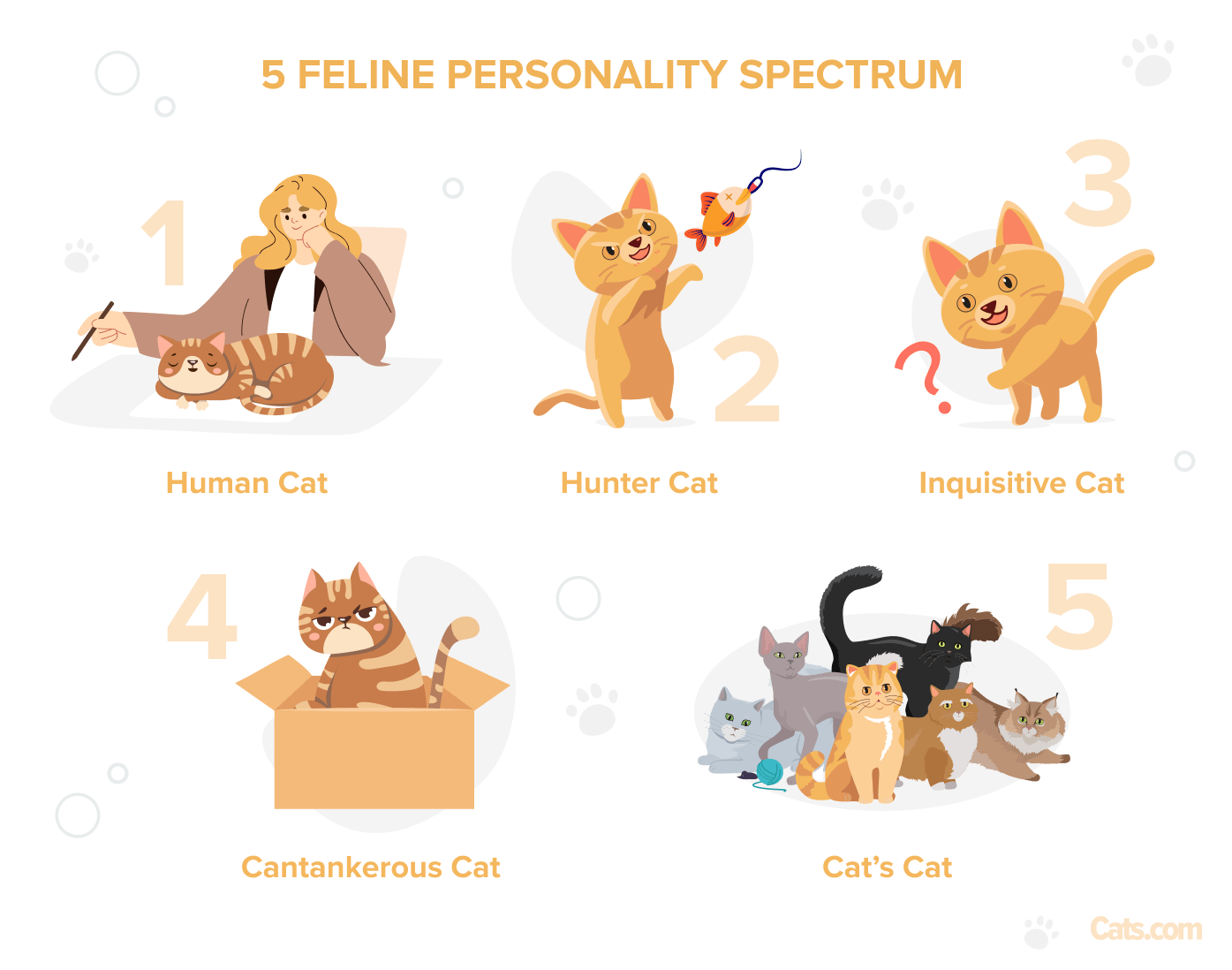
1. The Human Cat
The Human Cat is friendly and enjoys the affection of its pet parent. They love to share your space with you and are always ready to cuddle or be close to you. They probably want to sleep in your bed at night and right on your keyboard during the day. This cat is incredibly friendly, calm, and responsive to people. They show affection by messing around and will get lonely without attention every day.
2. The Curious Cat

Kirsten McCarthy
A Curious Cat is eager to investigate the smells, sights, and sounds around her. This instinct is formed by early exposure to new stimuli during socialization and residency. This cat will thrive in an energetic environment with new people and exposure to novel events and settings on a regular basis. Keep them busy with puzzle toys, food boxes, and cat forts.
3. Hunter Cat
Hunter Cat exhibits a very dangerous hunting behavior by stalking and catching prey. Indoor-only Hunter Cats will especially enjoy “hunting” inanimate objects such as mice and feathered toys. They might even present you with their latest kill as a gift! Embrace these risky behaviors to prevent boredom and dissatisfaction.
4. The Big Cat
The Cantakerous Cat’s love language is definitely not physical touch. They don’t make sense, they just want you to respect their space—and that’s okay! They are sensitive to touch, very sensitive to their nature, and easily frustrated. Be patient, keep them comfortable, and love them on their terms. They may even like to be close to you—they just don’t pick you up or pet you a lot. Provide plenty of toys for independent play and respect their boundaries.
5. Cat of Cats
Despite being a single breed, the Cat enjoys sharing its home with other cats. These animal companions may or may not be related and may be bonded pairs. Cats like these may have been socialized with other cats when they were young. They will play, groom, and hug their roommates. They may not mind being left alone at home because they have an important friend.
Each cat has a unique temperament with a genetic link. When choosing a kitten or senior cat to live with you, consider their personality to make sure they are a good fit for your family and lifestyle. This will help improve the human-cat bond, reduce the cat’s frustration, and improve their well-being.
Frequently Asked Questions
How do you describe a cat’s personality?
A recent research analysis suggests that cats have five personality types although some cat parents disagree. Thirty years of research into the personality of the bull has identified a multi-faceted way to describe the cat’s personality such as friendliness, courage, curiosity, questioning, fear and more. A better understanding of your cat’s temperament can help them have the best possible health.
How do you match a cat’s personality with your lifestyle?
Decide if you live a quiet, busy or noisy life with noisy children before getting a kitten, similarly do not choose a nervous, fearful kitten because it may turn into a depressed cat if your home is not suitable and your time is not good. Finally decide whether you would like an indoor only cat or an outdoor cat that spends more time hunting and less time interacting with people. Find the right cat for your personal circumstances by choosing a female companion based on her character, genetics, early mating and behavior rather than looks.
Is a cat’s personality influenced by coat color?
Scientific evidence linking personality traits to cat coat color is lacking in nature. Judging a cat by the color of its coat is a common misconception and is detrimental to a cat’s future husbandry and well-being. Never judge a book by its cover or someone by their appearance, the same goes for cats!
one publication uses high-quality, reliable sources, including peer-reviewed studies, to support the claims in our articles. This content is regularly updated and revised for accuracy. Visit our About Us page to learn about our values and meet our vet review board.
-
Care, IC (2018, October 04). Choosing an Adult Cat. International Cat Care.
-
Isadora de Castro Travnik, D. d. (2020, August 24). Temperature in Domestic Cats: A Review of Approaches, Experimental Methods, Its Effects on Human-Cat Relationships, and Individual Welfare. MDPI10, 1516.
-
Milla Salonen, KV-T. (2019, May 28). Increase the diversity of rewarding behaviors in cats. Scientific Reports, 79492-7. Retrieved August 23, 2021.
-
Salla Mikkola, MS (2021, July 01). Reliability and Validity of Seven Behavioral and Personality Traits. MDPI1-17. Retrieved August 22, 2021.