
Kirsten McCarthy
Cats have a variety of vocal sounds. In fact they have the largest vocalization patterns of all carnivores, they can make almost 100 different sounds compared to dogs who can only communicate 10 sounds.
Cats communicate between members of their species and other species to express their feelings in their own unique way. Researchers have found that the environment plays an important role in vocal behavior when wild and domesticated cats vocalize differently.
Let’s review the most common sounds that cats make and explain their meaning.
Voice Communication
Despite the fact that the domestic cat is a solitary species, domestication has led to several social and behavioral changes and adaptations to socialization and communication to suit the cat’s needs.
Verbal communication is divided into four categories:
- Agonistic interactions
- Playing with sex
- Queen-kitten interaction
- Cat-human conversations
In one study vocalizations were classified as grunts, vowels and strong intensity patterns while in another study, researchers classified the sounds of cats with a closed mouth, a constant open mouth and sounds produced with an open mouth slightly closed.
Differences were also seen between domestic and domestic cats with domestic cat vocalizations of higher frequency but shorter duration during human interactions involving more human interaction.
List of Cat Names
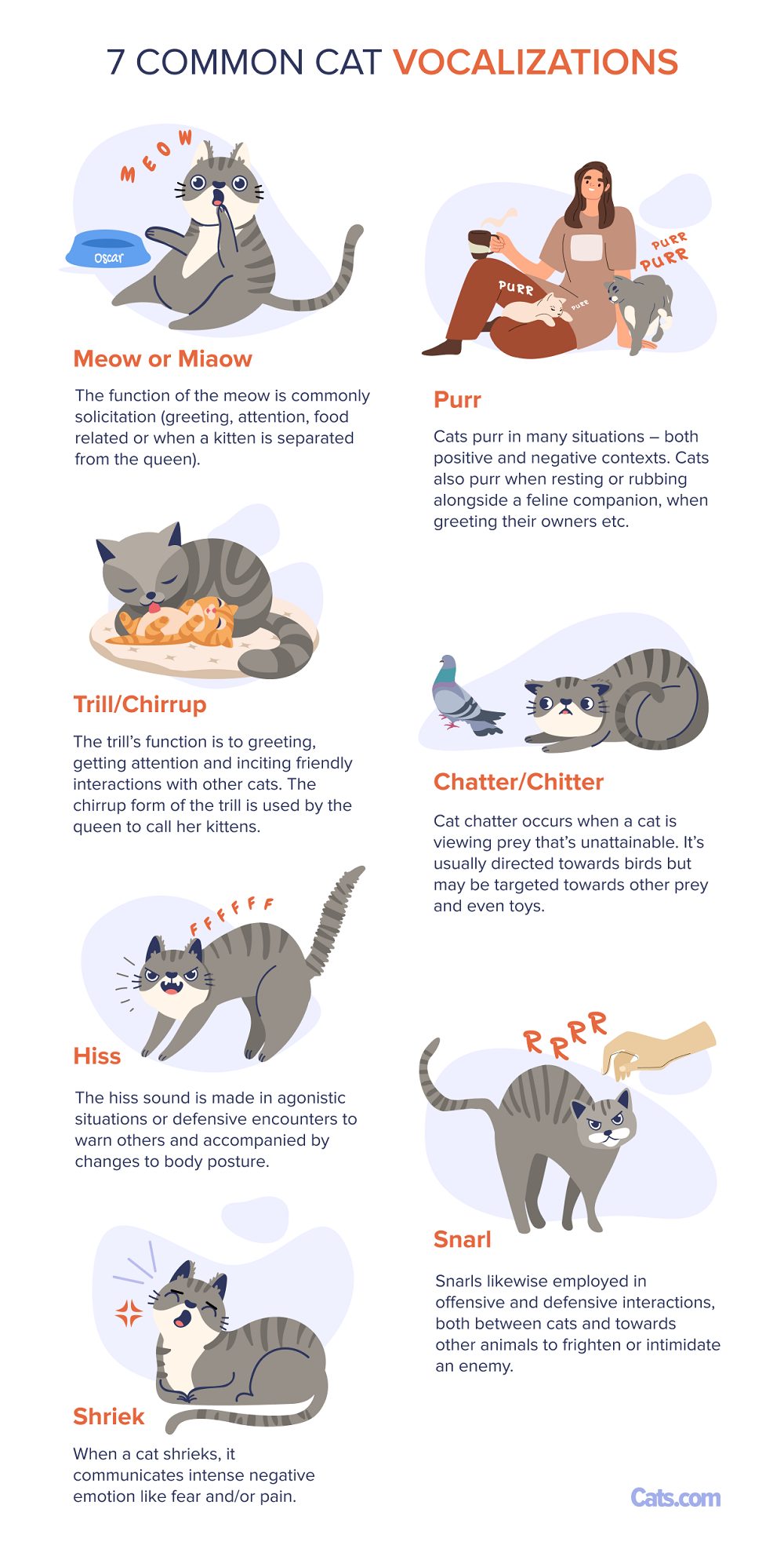
The most common names that cats make and what they mean:
1. Meow or Miaow
Cats make a wide range of meowing sounds, varying in intensity, length and frequency that occur in a wide selection of contexts with a very large number of variations that tend to convey different messages.
Cats tend to direct their meows more at people than at other cats. Although meows are heard during cat-cat exchanges, they are rarely heard during cat-cat interactions.
The function of meow is often to request (greeting, attention, related to food or when the kitten is separated from the queen). If the motivation for the meow is frustration (not being able to reach out or get food), the meow can be long and frequent.
2. The Purr
Puring is the most well-known single-tone purring sound among all low-pitched vocalizations made by felines.
Purring is produced by the contraction of the laryngeal muscle when the mouth is closed during breathing, it will be heard both during inhalation and exhalation, giving a rhythmic characteristic that will continue for a long time.
Felines can adjust the volume with which they purr, depending on how strong they are emotionally, the most prominent being the volume of the purr that can be changed between individuals, some flowing at inaudible levels and others making a noise that keeps the owners awake at night.
Cats are green in many situations – both positive and negative situations. Queens ovulate while nursing kittens while cats ovulate while nursing. Cats also purr when resting or rubbing close to a female companion, when greeting their owners and when being petted or groomed on the owner’s lap, it is thought that purging in such cases indicates satisfaction.
Listen to this video to hear a cat purr.
Veterinarians and pet parents have noticed that some cats vomit when they are in labor and a few have seen queens vomit during labor.
There is not enough evidence to conclude the act of purging during adverse conditions, however it is possible that purging in such conditions has opportunities for livelihood and pain relief.
3. Trill/Chirrup
The trill’s job is to communicate and greet, get attention and promote friendly interactions with other cats. A chirrup type of trill is used by the queen to call her kittens, however, it also occurs among older cats.
Trills and chirps are directed at humans and occur along with meowing. The high-pitched chirp sound is thought to mimic the chirping of birds or rodents to attract prey.
Watch this cat play with its owner when he wakes up
4. Chatting/Chittering
Cat chatter occurs when a cat is looking at prey that is out of reach. It is usually directed at birds but may be directed at other predators and even toys. The clicking sound is produced by a sequence of the jaw and the mouth wide open.
No one is sure of the exact function of this behavior, however there are several theories that include conflict symptoms of frustration at finding prey, anticipation of prey capture, impersonation of prey vocalizations and the homicidal theory.
In this video, a cat talks while playing with a toy with feathers.
5. His own
The scream is recognizable because of its distinctive sound. A whistle is a long exhale while the cat’s mouth is bared.
There is little difference between cats in the hissing noises they make compared to meows, yowls and shrieks. The hissing sound is made in stressful situations or as a defense mechanism to alert others and to accompany changes in body posture.
6. Snarl
Snarl sound occurs during rapid inhalation. A harsh, loud, high-pitched voice produced with an open mouth usually during active anger or when in pain.
Snarls are also used in offensive and defensive interactions, both between cats and other animals to intimidate or frighten an enemy.
7. Shouting
When a cat cries, it communicates a negative emotion such as fear and/or pain. If the threat becomes stronger by getting closer, the female may emit a sudden loud noise to scare off the enemy and allow the cat to quickly flee or attack (Brown and Bradshaw, 2014).
A cry of pain is a short, powerful cry of tense vowels that is expressed by a greater tension of the mouth and throat as well as the force of breathing (Moelk, 1944).
The conclusion
Cats can communicate well and if we pay close attention to their vocalizations, body language and facial expressions, we will see that they are trying to communicate with us and convey important information about their overall health and well-being.
Frequently Asked Questions
What do my cat’s words mean?
Your cat will make unique sounds to express how it feels and to communicate with you and other cats. Different sounds can vary between people and breeds, you will have to interpret the context and the message your cat is trying to convey. Some will convey joy, comfort and excitement and others frustration, fear or pain.
What are the different cat sounds?
The sounds a cat makes are divided into three groups: vowel sounds, purring sounds and hostile calls. Vowel sounds produced when a cat opens and closes its mouth such as meow, hiss or chatter. Moaning sounds are usually made with the mouth closed such as purr, trill and chirrups while tense sounds are made with the mouth open used in offensive or defensive interactions such as yowl, hiss, snarl, spit and growl.
What are the 16 most popular cat names?
Cats are intelligent animals that can understand between 20 – 50 words including their name. They recognize short words and associate them with your tone of voice, voice and body language associated with play, feeding, stimulation and petting. Common cat names are meow, purr, paw, cat, head, ear, nose, eye, food, bowl, bed, mouse, bird, water, etc.
Why is my cat crying?
A hissing cat (a long and loud call) communicates several things. Usually yowling is a form of aggression directed at another cat or animal where the cat is expressing gratitude for a threatening situation or territorial invasion. Yowling may indicate pain, illness or convey a feline’s reproductive state during mating.
one publication uses high-quality, reliable sources, including peer-reviewed studies, to support the claims in our articles. This content is regularly updated and revised for accuracy. Visit our About Us page to learn about our values and meet our vet review board.
-
Atkinson, T. (2018). Functional Animal Behavior. Oxfordshire: CAB International, 22-28. Retrieved October 09, 2021
-
Care, IC (2018, October 05). Cat Communication. Retrieved October 13, 2021, from iCatCare:
-
Care, IC (2020, September 01). Unit 2: Senses and communication – Words and their use in communication. In the UK. Retrieved October 08, 2021
-
Chloe Tavernier, SA (January 2020). Feline voice communication. Journal of Animal Science, 18-21. Retrieved October 11, 2021, from
-
Heath, IR (2016). Ox Health and Welfare. St Louis, MO: Elsevier. Retrieved October 10, 2021
-
Schötz, S. (September 2015). Agonistic words in domestic cats: a case study. Lund University, (pp. 86-87). Retrieved October 11, 2021, from