

The best laptop for writers on the go isn’t the same as finding the best laptop, full stop. I’ve written chapters in a Lisbon co-op and a fan fighting a failed battle, I’ve filed a copy from a ferry to a Greek island—no store in sight. In Luxembourg, I sent the assignment from the airport because all the seats at the gate were taken.
After years of this, I’ve stopped caring which laptop reviews matter most. The specs that win are probably not the specs that save your week when you’re in the three-time zone at home and the deadline is closing. This guide is for someone who lives that life—the one who has his laptop and is his office, his filing cabinet, and sometimes the only common thing in the room. If that’s you, then the best laptop for travel writers solves the problems that travel brings.
What a Travel Writer Really Needs
The needs of a traveling writer are really different from those tied to a desk, and being honest about that difference is the whole game. Here’s what’s important, in order of how often it freed me.
Battery life you can count on without the program
You need real, measured hours of continuous work, because shops on planes, trains, and cafes are not offered. The number to look at is an independent web browsing test, not the manufacturer’s video playback figure. Reviewers rated the MacBook Air at about 15 to 15.5 hours of continuous web work in typical tests.
It’s that kind of metaphor that means you really stop thinking about power. Treat anything less than 10 actual hours as a laptop that will eventually let you down.
Weight and size you will forgive in the sixth hour of the day of travel
A difference of 200 grams sounds insignificant in the shop, but it feels big on your shoulder after a missed connection. A truly lightweight laptop for writers—anything close to or under 1.2 kg (2.7 lb) for a 14-inch machine that truly “forgets it’s in the bag”. MacBook Air (1.24 kg) and ThinkPad X1 Carbon Gen 13 (less than 1 kg), two highly recommended travel laptops, both stay in that range. But—and this is important—the weight isn’t just the laptop—it’s the laptop and the charger and adapter you need to use the laptop in another country.
A keyboard you can type 2,000 words on without getting bored
This is the one sheet that takes the most thought and most writers neglect until it’s time to publish. You are not a spreadsheet user; the keyboard is your tool. You want real key travel, about 1.5 mm is the sweet spot, which is why ThinkPads continue to win keyboard nods from sites like Tom’s Hardware. Logically placed keys and backlighting on dim flights and late hotel rooms are also a must. A laptop that works well on paper but isn’t fun to type on, especially for you, is a bad laptop.
Durability and usability for a busy life.
Your machine will spend time in overhead bins, get rained on between the taxi and the lobby, and be opened in questionably tight spaces. Look for a steel or carbon-fiber chassis and, ideally, a MIL-STD-810H durability test—and check if the product offers an international warranty, because a repair option that is only available in your country is not really a repair option.
Top Laptops for Writers on the Go
An all rounder

Apple MacBook Air (M5, 13-inch)
For writers who travel often and want one of the safest choices, the 13-inch MacBook Air is the best laptop you can buy, because it’s strong where travel punishes you and weak where you won’t notice. Apple updated the Air in March 2026 with an M5 chip, and the practical issue is less raw speed than everything else around. Its weight is about 1.24 kg, it runs quietly because it does not have a fan to cover the dust of a hundred cafes, and – the most important part – its battery is always strong.
The 2026 model also fixed one spec that the writer might be legitimately concerned about: now it starts with 512 GB of storage and 16 GB of RAM as standard, so the base configuration is no longer a trap. The keyboard is great, the trackpad is still the best in the business. In addition, Apple’s global service network means that a problem in most major cities has an answer. The honest trade-off is ports: you get two Thunderbolt 4 ports, MagSafe, and a headphone jack—no HDMI, no USB-A—so the little dongle stays in your bag forever. For the writer, that’s only a small tax.
The first horse of the keyboard

Lenovo ThinkPad X1 Carbon (Gen 13)
If you write for hours every day, the typing experience is non-negotiable. So the laptop I suggest is the ThinkPad X1 Carbon. Lenovo has spent two decades improving the one component that touches you the most. Reviewers almost unanimously agree that it offers a very high-quality keyboard: well-spaced, well-spaced keys with a snappy 1.5 mm of travel. After a long period of writing, that difference is the difference between flow and exhaustion.
The big screen that’s still moving
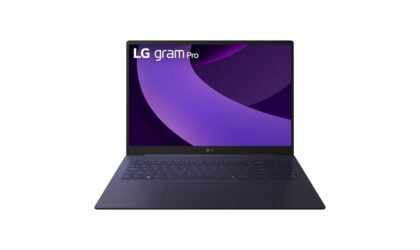
LG Gram (16-inch)
If you’ve been looking for an extra screen for side-drawing and researching but think a 16-inch laptop is too heavy to carry around, the LG Gram is the best laptop for you. He bends that rule. Gram’s entire raison d’être is a large-screen laptop that weighs as little as one—the Gram Pro 2026 16-inch comes in at just under 1.2 kg, lighter than most 13-inch devices, thanks to the new magnesium-aluminum “Aerominum” alloy. For the author, that extra display of real estate is not a luxury; the manuscript window and the research PDF open at the same time. Yes!
Choosing a value
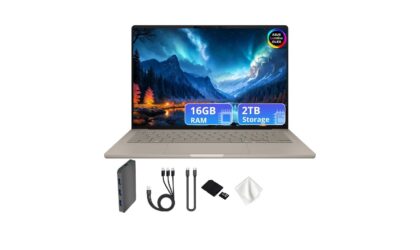
Asus Zenbook 14 OLED
If you want more of what premium machines offer for significantly less money, the Asus Zenbook 14 OLED is the best laptop for budget-conscious travel writers. It emphasizes the essentials of the trip without the premium price. It has been a repeated “best value” recommendation from reviewers for good reason: an aluminum chassis with MIL-STD-810H durability, a weight of about 1.2 kg, a comfortable keyboard that moves well, and a large 75 Wh battery that delivers real endurance throughout the day. The highlight is the OLED display—deep blacks and accurate color make reading and editing easier on the eyes than a typical budget panel.