

Top choice
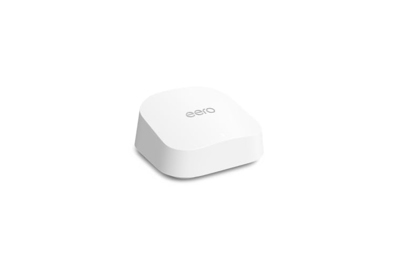
The Eero 7 uses stable Wi-Fi on a busy network and surpasses the price options. And it’s much easier to set up than complex systems.
The Eero 7 is quick to set up, inexpensive compared to competing Wi-Fi 7 mesh systems, and capable of distributing a flawless Wi-Fi network throughout your home. We tested the Eero mesh system throughout a three-story house, where it performed significantly better than systems costing two or three times as much.
Fast enough gigabit service. During our testing, the Eero 7 provided speedy performance, clocking in at 806 megabits per second (Mbps) when our test laptop was close to the base router. Speeds dropped a bit when our laptops connected via the second Eero 7 channel, but overall they kept speeds between 56 Mbps and 560 Mbps, which is more than enough for multiple 4K video streams and game downloads at the same time. Some of the more expensive Wi-Fi 7 mesh networks, such as our upgrade pick, the TP-Link Deco 7 Pro (BE63), finally tested faster overall. The average speed of fixed broadband, which includes both cable and fiber Internet service providers, was about 300 Mbps in October 2025, so a range of 56 Mbps to 800 Mbps is acceptable in most homes in the US.
Setup is easy. The Eero 7 should take five to 20 minutes to set up, much faster than other mesh networks we’ve tested, which can take over an hour. After connecting the Ethernet cable to your cable modem or fiber gateway, and the included USB-C power adapter, there is the usual prompt to set up your network name (SSID, service set identifier) and network password. Then the app gives you tips for placing the second Eero unit. After setting up both Eero units (and performing an automatic firmware update), you should have a working mesh network in your home.
The Eero app is easy to use. It lets you switch between WPA3 security and the WPA2 security built into older routers, but that’s one of the few settings you can change beyond the network name and password—making it easy for a novice or remote family member to monitor the network. All Eero and Eero Pro systems have a built-in switch for their 5 GHz network, making it easy to connect smart devices like cameras and doorbells.
Compatibility and support are strong. All Eero systems currently available are compatible with each other. For example, you can add an Eero Pro 7 or Eero 7 system to an existing Eero 6 network, if you need to cover more space throughout your home. Eero 7 (and other Eero systems) supports HomeKit, Matter, Thread, and Zigbee, four smart-home standards for controlling your devices. Because Eero’s parent company is Amazon, the latest Echo devices and the Alexa voice assistant are also supported.
It can handle a lot of traffic. In our responsiveness tests, the Eero 7 was competitive with the best mesh systems. Even when the Wi-Fi network was congested, the Eero 7 was able to stream 4K videos, download large files, and keep most of the web browsing sessions lag-free. Some more expensive systems, like Asus’s ZenWifi BQ16 Pro, slow down when the network is busy.
Eero offers mobile internet backup. Eero is one of the first mesh network makers to offer plug-and-play Internet backup to Amazon Eero Signal, a separate service that offers 4G LTE connectivity for $100 or 5G for $200. You keep the Eero Signal plugged in next to the base unit, and it will automatically switch when your main internet goes down. A $100 annual Eero Plus subscription includes 10 GB of data, and with Eero Plus 100, you can get up to 100 GB per month for $200 per year. Some manufacturers, such as D-Link, offer mesh networks with built-in 5G data modems. But Eero Signal doesn’t require you to sign up for a separate mobile data plan; backup service is included in (and managed by) Eero Plus. Eero Signal can be a handy backup if you have intermittent spotty internet service that can be knocked out by construction in your area or heavy rain or snow storms. We will be testing Eero Signal soon.
An Eero Plus subscription includes an option to create an online backup using your phone. You can connect your phone with the Eero app and use its limited hotspot data, which can be useful, but may not always be a reliable backup option.
Internet backup may be active if your primary Internet is unavailable (such as a power failure or if your cable or fiber ISP is down). But you’ll need a separate battery backup, such as a portable power station, to keep the Eero 7 running if the power goes out.
Flaws but not dealbreakers
The simple design sacrifices ports. It has only one 2.5-gig Ethernet port on the base unit and two on the secondary router. In contrast, our upgrade pick, the TP-Link Deco BE63, has four 2.5-gig ports on each router.
Optional subscriptions are expensive. Eero charges between $100 and $120 a year for its Eero Plus subscription, which is required to access parental controls and anti-malware protection — features that Asus’ ZenWiFi plans bundle for free. Eero Plus registration is completely optional, however: The Wi-Fi network will continue to work without parental controls and anti-malware.
Dual-band Wi-Fi 7. To save on costs and reduce complexity, the Eero 7 uses a 6 GHz radio that expensive Wi-Fi 7 and 6E mesh routers don’t have. Eero also left that feature to make the Eero 7 available in countries and territories that heavily restrict the 6 GHz radio bands. The 6 GHz bands may be faster, but they also have a shorter range than the 2.4 GHz and 5 GHz bands. This ultimately makes the Eero 7 less noticeable if you already have laptops with Wi-Fi 7-and if you have an internet connection faster than 2.5 Gig. If you are part of that group of beginners, our upgrade option may be a better choice.
You have to manage the mesh network in the cloud. Technically, bad actors can monitor your data with this login, although Amazon and Eero claim to protect your data and online activities. Mesh networks from Asus, Linksys, and Netgear also use login and setup apps, but the last three (and a few others) give you the option to manage each router locally using a web page.
You must use the Eero app to manage the network. It is not flexible. There are very few settings you can change in the app, making Eero not as flexible as its competitors. Many of the standalone routers and other mesh systems listed here will allow you to set parameters such as 5 GHz and 2.4 GHz channels, wireless signal strength, and the ability to create separate network names (SSIDs) to keep home devices separate from your mobile network.
While now owned by Amazon, the Eero company developed and released its first two generations of mesh networks outside of Amazon. We think the ease of setup, regular firmware updates (as needed), the ability to add Eero units to expand coverage, the ability to manage the network remotely, and the company’s proven track record outweigh these concerns.
Eero has successfully assigned an ID
Overall, we’ve had good to great experiences with the Eero 7 and other Eero models. As my family’s technology manager, I kept my parents’ Eero home network flawless, while controlling it remotely and monitoring automatic firmware updates from my phone. Senior staff writer Tim Heffernan installed the Eero 6+ to provide a “solid, solid” connection in the back room where our previous Wi-Fi extender choice, the Asus RP-AX56, couldn’t reach in their apartment. Senior editorial partner Christine Ryan, who owns and manages an Airbnb rental, “loves her Eero mesh network, because it provides great Wi-Fi throughout (the two floors and the top floor), and she gets a notification whenever someone checks in, so she knows when guests have arrived.”