
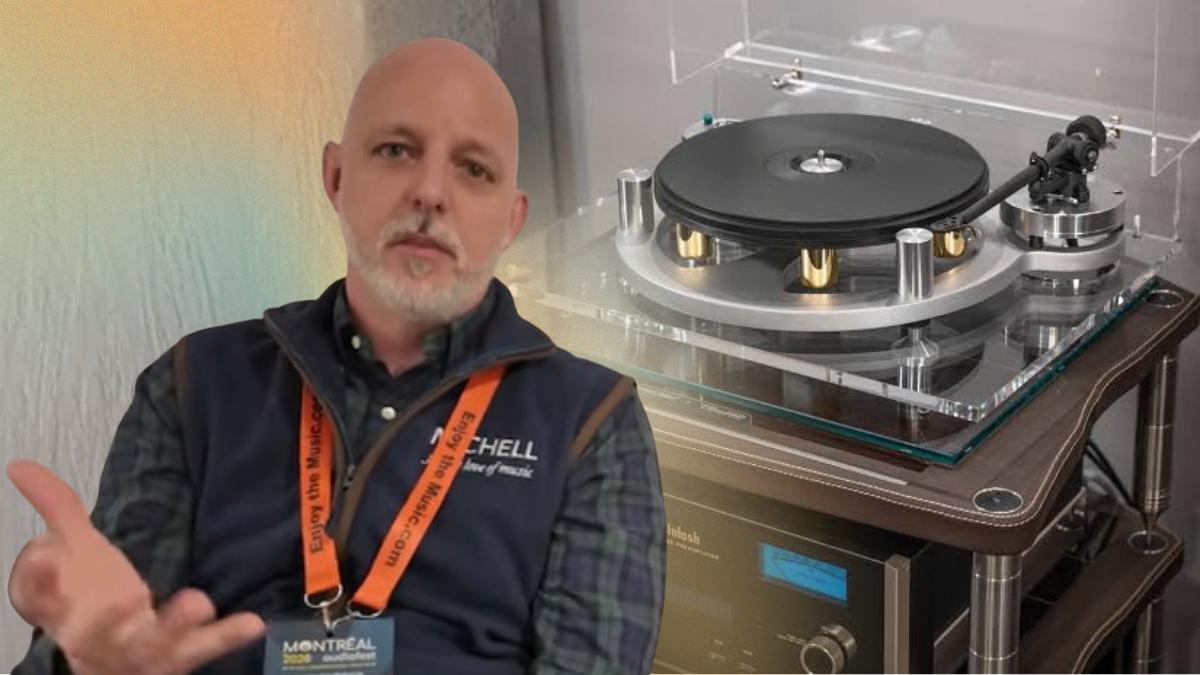
Decades of incremental tuning were replaced by a method that no one fully describes.
For 43 years, the Michell GyroDec was the British turntable in Steve Jobs’s 1982 photo, Roger Waters and Paloma Faith’s desk, and the SME reference used to develop its best tones.
At the end of 2025, Mitchell Engineering stopped it. The GyroDec and its long-time sibling the Gyro SE are both gone, replaced by a single turntable called simply the Gyro.
The reason, according to managing director Jonathan Nye, was AI.
Forty-Three Years, Then It Was Gone
The first GyroDec came off the line on January 17, 1982, bearing the serial number 001 and a list price of £590. What followed, over the decades, was a pattern of revisions.
The individual pieces were redrawn one at a time, the plate and bearing and power supply, but the deck itself was not reworked. GyroDec remained GyroDec.
In the British audiophile press, it collected the kind of explanations usually reserved for classic cars, and the short was not at all distracting.
On October 16, 2025, at the Cromwell Hotel in Stevenage, Michell gathered dealers and trade media to see the turntables that will replace it. The new Gyro lists at £5,995 without arm or cartridge, alongside a new mid-tier deck called the Revolv at £3,995.
Both ship before the end of the year, the Revolv in November and the Gyro in December.
And GyroDec is out of production. The Gyro SE, its long-running sibling that shares the same engineering, has also gone out of production.
What Michell showed that afternoon looked, at first glance, almost identical to what it replaced. That was the short of it. Underneath the standard frame, the deck is new from the chassis up.
So what replaced 43 years of accumulated engineering? According to Mitchell, the AI model.
What One Actually Says
The old GyroDec chassis, Nye said, was sandblasted aluminum with counterweights installed. There is no new one.
“The main chassis is now instead of being a piece of sandcast aluminum with just counterweights on it, it’s a system where it’s machined from an aluminum tooling plate.” he explained.
“We can model everything and figure out what the vibrations and resonances are going on there. Um and then there are brass weights that are carefully placed in different positions of different sizes to dissipate the force. So now it’s what we call a force control chassis.”
Michell writes the resulting engineering in practical terms. 19mm aerospace-grade aluminum chassis with integrated copper weights. Equilibria tuning down from 4.5Hz to 3.5Hz.
Double-helix oil pump, twice the lubrication flow of the predecessor.
Sorbothane’s six-node pedals are tuned from 20 to 115Hz.
What the alleged AI characters were doing, by Nye’s account, was listing all the sources of vibration they had to contend with.
“You’ve got structural vibration coming through. You’ve got music in the room. You’ve got rotating bearings in the center. You’ve got tonearm vibration. All these different things need to be addressed and that’s where we’ve had a big improvement in performance over the old model.”
With the philosophy of suspension, Nye reached an analogy.
“[When] you’ve got all this weight and the springs are tight and you’re sloshing around at the bottom, like jelly. If you have a turntable weight and the springs hang so the springs expand, they are naturally stable.
There’s a lot you want. And, it turns out, there’s a lot to prove.
What Research Can and Can’t Confirm
The details are cleanly convincing. Every physical attribute described by Nye also appears on Michell’s official product page, SoundStage!
Global launch, The Ear, Hifi Pig factory tour, and Twittering Machines.
Those are ten independent sources, with each number corresponding.
Which does not guarantee the way of working behind them.
There is no source that calls for a specific software package. Not Ansys, not COMSOL, not Altair, not Abaqus, not a machine learning pipeline. No before and after measurement data appears anywhere in the public record. There is no white paper accompanying the presentation. There is no engineering post from Michell explaining how the modeling was done.
Language changes from source to source. In the Montreal interview, Nye once called it an “AI model.” Michell’s product page calls it “AI-modeled vibration control and structural optimization,” still just AI.
Media coverage continues. SoundStage! Global writes that “advanced FEA (finite element analysis) and AI simulation were used to model the power flow throughout the chassis.” Twittering Machines produces similar terms with “AI-optimized vibration control using FEA and simulation.” Both shops access FEA. It doesn’t even explain why it was run or what it came out of.
The FEA framework remains in the media copy. It doesn’t come from Nye’s voice. Whatever the software is, he doesn’t name it, and neither does anyone else. This is what the episode itself says, not third-party criticism. No outlet covering the launch has questioned you. Marketing continued before the documents.
The engineering results are real. The working method behind them is the sentence on the product page.
That’s important, because in 2026 “AI modeling” is not the difference in Michell’s media position.
Nobody Else Says It
In microphones, computer modeling of table stakes. KEF and Bowers & Wilkins have published finite element analysis work on driver and cabinet design for over two decades.
B&W’s formulation reads that the company uses “laser interferometry and finite element analysis to accurately predict and optimize driver performance prior to physical prototypes.”
This sentence could have come out with a press release in 2005. 2026 is wallpaper.
On turntables, the peer set is silent. No Rega, Linn, Pro-Ject, Clearaudio, VPI, or SME launch in the past decade has made a comparable public AI or FEA claim for analog design.
The design philosophy outlined by Rega works the other way around. The company’s position in society is that “quantity absorbs energy and that ends up taking the life out of the music.” Counting is beside the point when you’re trying to keep the deck simple since you can’t get out.
Three readings of Mitchell’s outsider situation come to mind.
- First, the company is truly ahead of its peers in computer design.
- Second, it is the first to adopt a language that peers don’t bother with.
- Third, peers use the same tools but keep quiet about them. Available testimonials do not pick a winner.
Less confusing is what happens in the engineering shop area.
Made in Britain, Machined Elsewhere
The new Gyro is made in Britain. It is also machined by someone else.
At the Montreal Audiofest, Nye laid out what’s happening in that store now.
“We use one main contractor for the music production. So they are an extension of us,” he said.
“Back in the ’60s, ’70s, and ’80s we made all the parts in-house. Um unfortunately our economies of scale now can’t do that anymore. Um and new machines to get these big to buy a big CNC machine for half a million quid you need to be working 24/7.”
Programming precedes AI redesign. Audiophile Man’s factory report, filed ahead of the 2025 launch, describes a similar setup. Parts cut by UK subcontractors, raw materials supplied by Michell, assembly and QC in a six or seven man workshop.
“He is one main contractor,” added Nye. “We have other little bits and pieces, but everything is made in the UK.”
Steve Rowland, Operations Manager and Nye’s father-in-law, provided the philosophy behind the arrangements in the same report.
“Right or wrong, John wouldn’t do it that way. And I wouldn’t do it either,” Rowland said, explaining Michelle’s refusal to go overseas.
Nye married into that lineage with Rowland, making her the great-grandson of founder John Michell. The arrangement of the outsourced UK subcontractor preceded its arrival in 2015 from the domestic machinery industry.
If a company no longer cuts its parts, it no longer tunes by hand, and the AI/FEA pipeline, whatever it really is, fills the void.
Whether that framework has spread to analog heritage or remains Michell’s alone, the peer set has yet to answer.
The rest is a matter of caution. Provable engineering wrapped in unprovable, shop-built steel, within a silhouette designed to keep three generations of GyroDec owners unawares.
Nye says: “The only caveat is that we wanted it to look old.”