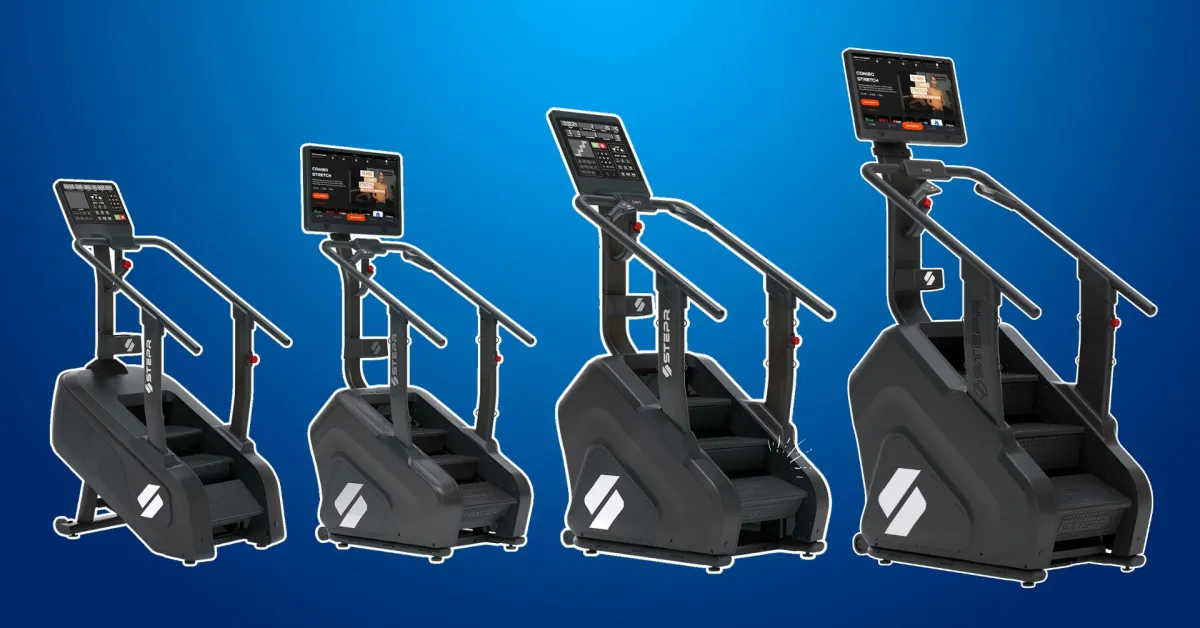
Stair climbers have become one of the most sought-after cardio machines in home gyms, and STEPR is leading the way. But with four different models (STEPR Go, Home, Pro, and XL) it can be difficult to find which one is right for you.
In this side-by-side comparison I’ll explain how they differ, and which one you should get depending on your goals, location and budget.
Floating step design
All four STEPR models share a common foundation: a compact, belt-driven system that feels smoother and quieter than most gym climbers. The main difference is in what STEPR calls a floating step design.
In a typical stair climber, each step connects to the one above it at a 90-degree angle, which can cause your toes to pinch the edge of the next step. It’s subtle, but over thousands of steps it becomes uncomfortable, especially for users with big feet.
STEPR eliminates that problem entirely. By separating each step to “float” independently, your toes never hit the front step. The result is a natural rhythm that reduces impact and makes you feel better over time.

STEP Go
STEPR Go is the most compact and affordable model in the lineup. Developed in partnership with Dick’s Sporting Goods, it is designed to deliver the STEPR experience in a convenient, budget-friendly package.
It features a 5.2-inch stride length, giving you a quick, athletic stride that feels more like running the bleachers than climbing the stairs. The Go tops out at 120 steps per minute, which is fast enough for both intervals and intense cardio.
If you are used to climbing large commercial stairs, the short step length may take a few practice sessions to get used to. When I first started, I kept expecting a deeper feeling of the exercise machine. But after about a week, the short movements felt completely natural and worked even better in the high intensity sessions.
The Go is lightweight, fits through standard doors, and moves easily on its transport wheels, making it ideal for apartments or home gyms with limited space. It comes with an LED console only (no touchscreen option) and doesn’t include resistance-band hooks like higher-end models.

Home of STEPR
The STEPR home is an original design and remains one of the most balanced options overall. It shares the same 5.2-inch step length as the Go but with a heavier weight, stronger construction and a top speed of 140 steps per minute. The movement feels the same, quick and fluid, but the build quality feels closer to commercial machines.
It fits snugly under an eight-foot ceiling for anyone around six-two and easily passes through standard interior doors, making it a perfect fit for most homes and apartments. Unlike the Go, the Home includes resistance-band hooks on the base, allowing you to attach bands for upper-body or full-body training while you pedal. It’s a simple feature that adds an incredible amount of variety.
Home is available in two versions: standard LED console or Classic+, which adds a 27-inch touch screen. That screen opens up scenic routes, over 100 on-demand classes, monthly challenges, and full workout tracking, all with subscriptions.
STEP Pro
STEPR Pro marks the transition to commercial-grade lighting performance. Its seven-inch step height gives each step more width and power, transforming the workout from quick cardio to something closer to real stair climbing.
For me personally, this is a sweet spot. A seven-inch stride strikes the perfect middle ground: deep enough to engage the glutes and hamstrings, but not so long that I have to slow down to keep up with the rhythm. The Pro’s balance of speed and power makes it a model I return to again and again.
The Pro is rated for light commercial use, meaning it’s designed to handle most daily users or very intensive sessions. It still fits under eight-foot ceilings, though taller users should double-check clearance. It’s wider than the Go or Home, so you’ll want a wider door or an open setup like a garage gym.
Features include resistance-band hooks, wireless phone charging, and a USB-C port. The Pro+ model adds a touchscreen with the same connected features found in the Classic+.

STEP XL data
At the top of the list sits the STEPR XL, a full commercial grade climber designed for gyms and training facilities. The nine-inch step length delivers a slow, deliberate climb that mimics the feel of large vending machines. Each step engages the legs fully, providing a strong, muscle-building movement rather than a fast cardio pace.
While many users prefer that deep, gym-style step up, I personally find the nine-inch step too long for my preferred speed. For me, the seven-inch Pro offers a better balance of range and rhythm. Still, if you like that full, heavy action, the XL delivers nicely.
The XL matches the Pro’s ability of 190 steps per minute, although most users won’t get close to that speed given the depth of the step. It includes everything from the Pro, including wireless charging, band hooks, and a USB-C port, as well as a pull-out tray underneath to catch dropped items. Because of its height, it requires more roof clearance and is better suited for dedicated gyms.

How do they compare
Each STEPR model scales in size and strength, but the basic movement remains the same. The Go and Home share a 5.2-inch step length for a fast, cardio-driven feel. The Pro moves to seven inches to mix depth and speed, while the XL tops out at nine inches in width and power.
The speed increases in line with the build quality: Go hits 120 steps per minute, Home 140, and both Pro and XL reach 180. The Go and Home is designed for home use, the Pro handles light commercial environments, and the XL is designed for full commercial use.
All models fit under an eight-foot ceiling, but if you’re over 6-2, the Pro might be tight and the XL might need more room. The Go and Home easily fit through standard doors, while the Pro and XL are wider and better suited for larger openings.
The Go is the only model without resistance-band hooks or touchscreen support. The Home, Pro, and XL all include hooks, and the Pro and XL add wireless charging. The touchscreen, available in the Home+, Pro+, and XL+, adds intuitive navigation, much-needed workouts, and streaming apps like Netflix and YouTube, all free of the membership fee.

Final thoughts
No matter which STEPR you choose, you get the same quiet, low-impact, floating motion that defines the product. If you’re looking for something lightweight and easy to transport, the STEPR Go is a solid entry point. If you want more stability and flexibility, Home or Home+ are the best options around. The Pro remains my personal favorite for its balance of power, speed, and overall feel. And for those looking for a true gym-grade machine, the XL stands alone.
The STEPR range is designed to grow in size and capability, not complexity, giving every model the same smooth experience with the added bonus of a fully featured, unregistered connected platform.