
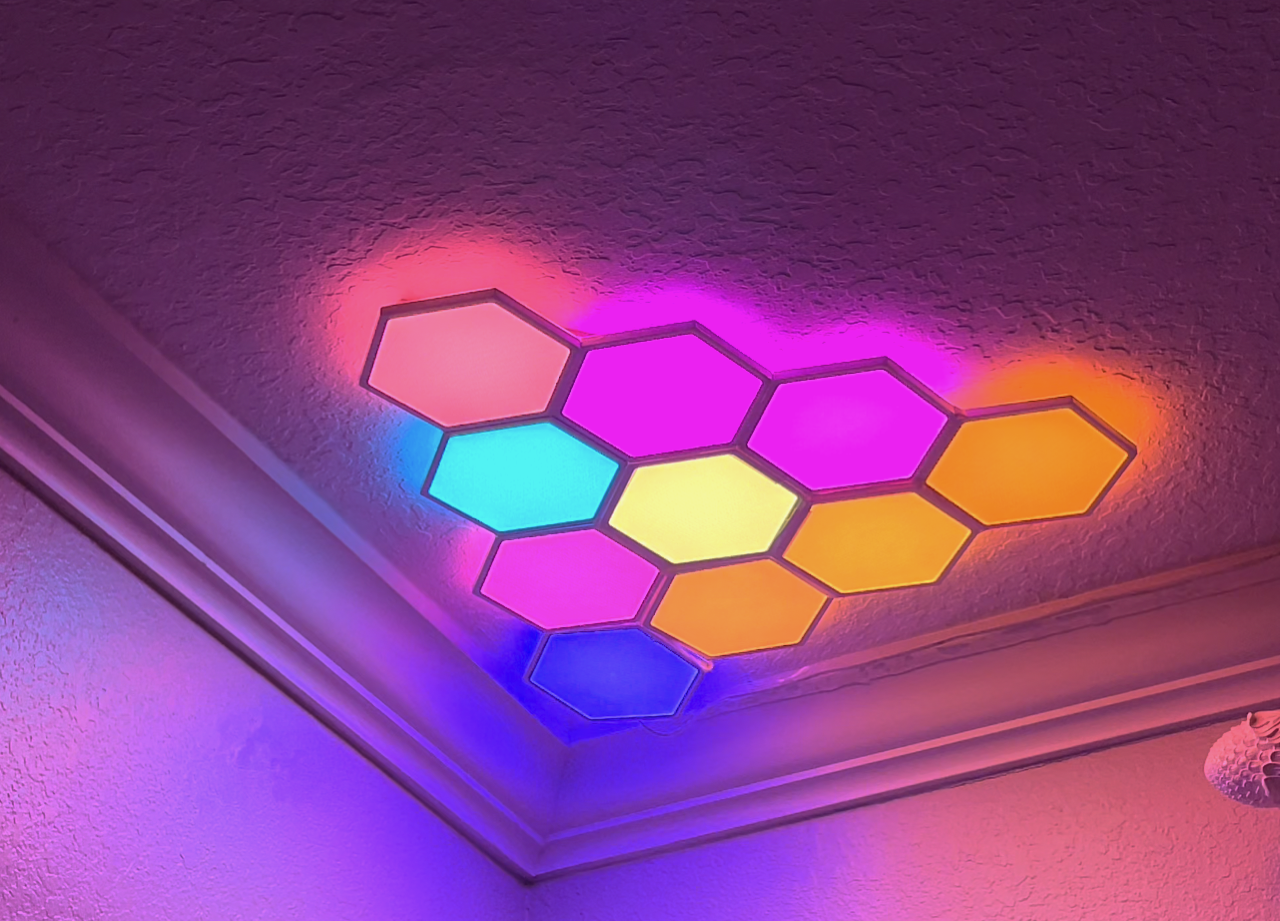
Meet the Sync light panels.
The Sync range of lights, called “C” at the time, were a product of GE Lighting. Savant bought part of GE’s lighting division, which includes a wide range of smart lighting.
Who is Savant? We’ve been doing it for almost as long as I’ve been in A/V, Savant has been a name, probably the biggest name in smart home and home theater installation.
What are they doing? These Sync Light Panels consist of a series of hexagonal (aka six-sided) panels, connected to each other. To review these Cync lights, Savant sent me their 10 panel kit. The package has everything you need to mount 10 panels to your wall, in any configuration you desire. You can add more panels at any time. I’m not new to using lights like this. A good 6+ years ago, I reviewed a “similar” product from the company Nanoleaf. (I’ll be commenting on some of the differences and similarities later, but most notably, these Sync Panels can have multiple colors within each panel, rather than each being a solid color. That makes climbing, in terms of looking cool.
List price for this configuration is: $189.99 A quick look online also finds you can buy seven-panel configuration for a list price of $149.99. Many sites turn down the lights. Amazon, right now (12/26/23) has the 10 panel set from $159.99.
Want to extend your Sync. Just add more panels. Cync offers a 5-pack expansion kit.
Most people who use products like this, such as color… I am one of them – multi-colored (and white) lights in our area. I have a second use, which is to help illuminate a large piece of glass art (sitting on a low light stand).

As you can see from the pictures (and my writing), to achieve this, I wanted to install the lights, not mount them on the wall.
That, folks, was the first and only major problem. The light panel kit has everything you need for wall mounting, but nothing for ceiling mounting. It gives enough stick to the tabs to hold the lights to the wall (similar to my old Nanoleaf lights, but not as good as holding them to the ceiling – I’ve tried them. Because of that I had to come up with a solution to install it on the ceiling, which I did, or rather, our assistant did. I will describe our first, and last (2n.d) efforts below. And a warning about the correct way to install the cables which will most likely save those of you who don’t read installation instructions, good time.

Notice that in the image above, each panel has multiple colors that keep changing with the pattern I chose. Some patterns use solid colors. And you can edit your own results.
They are really cute!

Application, Special Effects, Voice Control
It is highly recommended that you download the app to your iPhone or Android before you begin.
Voice Control is available using Alexa or Google Assistant. Matter makes setting up a snap, adding only seconds. I usually issue commands like turn on “Light Panels” and “Dim Light Panel to 35%” There is no doubt that I was able to program in the most advanced control as one can do with many products supported by Alexa and Google Assistant.
Thanks to GE/Savant! The app is the best in the Apple App store, 4.5 with 89,000 ratings! That’s pretty convincing, but given that it’s now owned by Savant, it’s hardly surprising. To keep setup and installation simple, Cync Light Panels support Matter, for quick, reliable setup.
Of course you can set schedules, choose from many pre-designed scenes, or create your own.
There are 12 preset special effects, you can see 10 of them in this App screenshot. There are a few that I like, some have all panels, all the time while changing colors (or not), others use patterns and cover certain panels while changing colors. Nice but none of those 12 will let you slow down or speed up transitions, and they won’t let you dim the light.
The good news is, when you select Scenes, in the Explore tab, you’ll find 27 additional scenes.
You can edit this including speed and color, rename, etc. If you save those, they end up under the Custom tab, and on the Scenes page.
Installation
Follow the instructions! Otherwise you might end up being too smart, like I was. I started with the instructions, I placed on the table the first light panel, the one that would connect to the power.
There are two pieces to each panel, the smaller connector piece and the larger light panel, the back of which cuts through the connector piece. The connector piece has 6 connectors for short cables provided.

All 10 panels are laid out in the pattern I want. You can see that I connected all the panels together, unfortunately, not following directionsI did it wrong. You cannot connect two or more panels to each other’s outputs. Each panel should have only one input and one output!
Note, the wires are marked with arrows on one side. The “power” panel connects to the low voltage cable/controller provided. Since I was creating a bowling alley like a 10 pin structure, I figured why not link to 1St panel to the two panels it touches. And then those connected to the ones below (picture above). That worked fine until I tried using the lights. The system did not know which local panels were the same.

This lighting system needs to know how the lights are connected, and the layout is straightforward, from 1 to 2.n.d3rdetc. There is no operation from one panel to 2 or 3 or more panels.
So, I removed the panels and their connection plates from each other, and reconnected correctly this time. And voila’ no problems at all. Let that be a lesson. Hopefully this will save you DIY types a lot of time re-doing.
You will tell it which panel is first, etc. by layering the panels in the app, in the same pattern you plan to use – you use their arrows to arrange the app panels to match the layout of the physical panels. I lay out my panels in a triangle, like bowling pins. I wired from one to the next, going down one side of the triangle to the next side, the last panel connected was the middle panel (#10 on my list of 10 panels) connected only to #9… Well done, and great!
GE Cync vs Nanoleaf Aurora
I first reviewed the Nanoleaf Aurora in 2017. Here is the review link.
Apart from the shape, of the panels (the first Nanoleaf panels were triangular, but they have released other shapes since then, (including hexagonal and square), the main difference is the ability of the Sync panels to make each panel do multiple colors at once and pass through them. (See video above). Nanoleaf panels were always only one color, any color you choose. That makes the Sync panels look cool. Also, Nanoleaf’s first panel system needs an option to respond to sounds/music. The Sync program offers many pre-designed and customizable scenes that respond to music and voice.
Essentials: Color Sync Hexagonal Light Panels
There are many competing products, not only from Nanoleaf, but also from Govee, Twinkly and other people from China. I do like, however, that Savant is a large US company specializing in home installations – a high price for that, which means they are (and have been) very customer focused! AKA support! Finding an App these days with a 4.5 rating in the Apple Store, translates to an easy-to-use, complete app.

The Cync product line also includes LED lights that look like neon tubes, as well as standard RGBW lights, the couple said. They look much better than standard RGB strip lights. I would say, like the light panels, they are very cool. Combine this with other Sync lights for more colorful fun.
Important point: I think they’re delicious, and, to my surprise, my wife doesn’t mind them in our living room. That’s really “proof” that colored light doesn’t have to be “higher.” – art
An update
Sync Smart Light Panels by Savant/GE Lighting
RESULTS
- Works well, installs easily (on walls), if you follow the instructions, which are easy to follow.
- Voice control with Alexa or Google Assistant
- I love the app, and like the color palette, I really like my living room.
- Multiple colors, single color, mixed color, or different white temperatures. Although I have shown many color photos, I will also use these panels to light my glass art, below, using just one color, or different temperatures of white color (from very warm to very cool).
- The prices seem reasonable, although you can buy knockoffs at a lower price, directly from China, re Temu, etc. Support: It’s your choice – save some money, and end up with little or no support, compared to spending more and buying a product from a legendary company for their pre and post sales support.
- Excellent complementary products, such as Neon “rope” and strip lights
CONS
- It can be a bit expensive
- More sizes and shapes would be great additions to the line
- A ceiling mounting kit can be very useful, and one that allows us to go from the ceiling to the wall
- Syncing music starts with a few clicks